




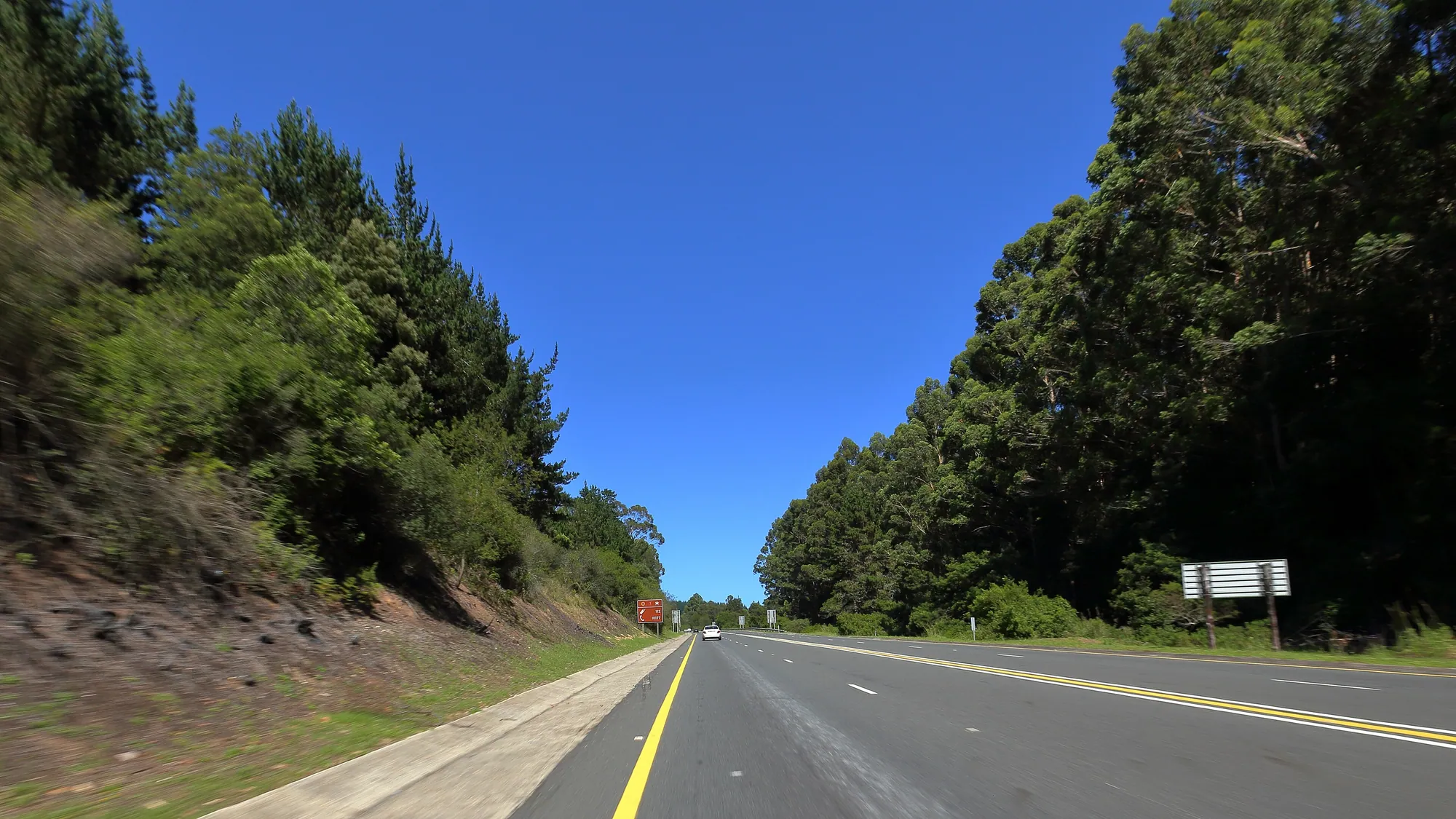
Driving and Getting Around South Africa
How to drive legally in South Africa, renew your licence and disc, pay fines and tolls, and use the Gautrain, city buses, minibus taxis, ride-hailing, coaches and domestic flights.
Last reviewed 25 Nov 2026
South Africa is a big country built around the car. Distances are long, cities are spread out, and outside a few city centres public transport is patchy. That said, Johannesburg, Pretoria and Cape Town have reliable options such as the Gautrain and MyCiTi, ride-hailing works well in every major city, and cheap domestic flights make long trips easy. This guide covers driving rules, licences, the annual licence disc, fines, tolls and fuel, then every main way to get around without a car. Fees and rules change, so treat the figures as a guide for 2026 and confirm with the Road Traffic Management Corporation (RTMC), your provincial licensing department or the operator concerned.
The basics of driving in South Africa
South Africans drive on the left and the steering wheel is on the right. If you come from a right-hand-traffic country, give yourself a few quiet days before tackling city traffic.
Key rules to know:
- Speed limits: 60 km/h in towns and cities, 100 km/h on rural roads, and 120 km/h on freeways, unless signs say otherwise. Speed cameras are common, including average-speed zones on some national roads.
- Seat belts are compulsory for every passenger, front and back. Children should be in a suitable car seat.
- Phones: holding a phone while driving is illegal, and some metros may impound the phone.
- Alcohol: the legal limit is 0.05 grams per 100 ml of blood (0.02 for professional drivers). Roadblocks are frequent, especially over holidays. The simple rule is not to drink and drive.
- Four-way stops are everywhere. Whoever arrives first goes first.
- Robots is the local word for traffic lights. When robots are out because of a power cut, treat the intersection as a four-way stop.
- Minibus taxis stop suddenly and often, so keep your distance.
Driving at night on rural roads is best avoided where you can, because of poor lighting, potholes, pedestrians and livestock. In cities, keep doors locked and windows up at intersections, and do not leave bags visible on the seat. Our safety and security guide has more practical tips, and save the key numbers from our emergency numbers tool: 10111 for police and 10177 or 112 from a mobile for emergencies.
Driving licences
Visitors and temporary residents
You can drive in South Africa on a valid foreign licence while you are a visitor or a temporary resident (for example on a work, study or visitor visa), provided the licence carries your photo and signature and is in English, or you carry an English translation. Many car rental companies also ask for an International Driving Permit, so getting one before you travel avoids arguments at the counter. Rental firms usually want you to be at least 21 to 23 and to have held a licence for a year or more. Check your options with our driving licence checker.
Permanent residents and converting a licence
Once you become a permanent resident, your foreign licence is generally only valid for 12 months from the date permanent residence is granted. Within that year you should convert it at a Driving Licence Testing Centre (DLTC). You will normally need your ID or permanent residence documents, the original foreign licence, proof of address, an eye test and photos. Licences from some countries cannot be converted, in which case you sit the learner's and driving tests. Rules are set nationally but processing is done by provinces and municipalities, so check with your local DLTC first.
Learning to drive from scratch
The path is a learner's licence (a computer or written test on rules and signs), then lessons, then a practical driving test at a DLTC. Waiting times for test bookings vary a lot by centre. Bookings for learner's and driving tests, and licence card renewals in many areas, are made through the national booking portal on online.natis.gov.za.
Renewing your licence card
South African licence cards currently must be renewed every five years, even though the underlying licence does not expire. In 2026 Cabinet approved moving most licence cards to a ten-year validity, but this still needs legal changes before it applies, so for now keep renewing on time. Driving with an expired card is an offence. Book the renewal on eNaTIS, visit the DLTC for an eye test and fingerprints, and allow a few weeks for the new card to be produced. You get a temporary licence in the meantime.
Owning a car: registration and the licence disc
Every vehicle must be registered on eNaTIS, the national traffic information system, and must display a valid licence disc on the windscreen. The disc is renewed every year. You get a notice before it expires, and there is a short grace period (commonly 21 days) after which penalties apply. You can renew at a municipal or provincial licensing office, at approved agency counters in some provinces, or online through the eNaTIS portal where your province supports it.
When you buy a car, the seller and buyer complete a Notice of Change of Ownership, and the buyer must register the car in their name within 21 days. Older cars need a roadworthy certificate from an approved test station before they can be registered to a new owner. Unpaid fines and licence fees follow the car on the system, so check before you buy.
Third-party motor insurance is not compulsory in South Africa, because the Road Accident Fund (paid through a fuel levy) covers some injury claims. Even so, comprehensive or at least third-party insurance is strongly advised. Vehicle theft and hijacking are real risks, and many insurers require a tracking device on popular models.
Traffic fines and AARTO
Today most fines are still issued under provincial and municipal systems and the Criminal Procedure Act. You may get a notice through the post, by SMS or email, or a ticket at a roadblock. Many metro traffic departments let you pay online, and you can check outstanding fines with our traffic fines tool. Unpaid fines can lead to a summons or a warrant, and they can block licence disc renewals, so deal with them promptly.
The Administrative Adjudication of Road Traffic Offences (AARTO) Act is replacing this system in phases. The national rollout began on 1 July 2026, and AARTO notices now apply in a growing number of municipalities, with further phases planned through late 2026 and into 2027. Under AARTO you can pay early for a discount, nominate the actual driver, or make a representation. A demerit points system is part of AARTO but, as of late 2026, it had not yet been switched on, and it is linked to a later phase. Check aarto.gov.za for the current status in your municipality.
Toll roads, e-tolls and fuel
Tolls
Many national routes, such as sections of the N1, N3 and N4, have conventional toll plazas where you pay by card or cash. Fees depend on the plaza and vehicle class. An electronic tag (e-tag) from SANRAL lets you drive through dedicated lanes.
The Gauteng e-tolls on the Johannesburg and Pretoria freeways were scrapped in April 2024. The overhead gantries still stand and are used for traffic and law-enforcement purposes, but you no longer pay to drive under them.
Fuel
Fuel prices are regulated and change on the first Wednesday of every month, announced by the Department of Mineral and Petroleum Resources. Inland prices are higher than coastal prices because of transport costs. In November 2026, 95-octane petrol cost about R30.24 a litre inland and R29.37 at the coast, and prices move by anything from a few cents to over R1 a litre each month.
Petrol stations are full service. An attendant fills the tank, and often checks oil, water and tyres or cleans the windscreen. A tip of around R10 to R20 is customary. Most stations accept bank cards, but some fuel cards and garage cards are not accepted everywhere.
Getting around without a car
Gautrain (Gauteng)
The Gautrain is a fast, clean rail link between Johannesburg, Pretoria and OR Tambo International Airport. The north-south line runs from Park Station in central Johannesburg through Rosebank, Sandton, Marlboro, Midrand and Centurion to Pretoria and Hatfield. The airport line runs from Sandton to OR Tambo in about 15 minutes. Fares are distance based and higher at peak times. You pay with a Gautrain card or by tapping a contactless bank card. The Sandton to airport trip is one of the most expensive single journeys, roughly R230 to R250 as of 2026. Estimate your trip with our Gautrain fare tool and confirm on gautrain.co.za. Feeder buses serve the stations.
City bus systems
- MyCiTi (Cape Town): a bus rapid transit network covering the city centre, the Atlantic Seaboard, the West Coast suburbs, the airport and parts of the Cape Flats. You pay with a myconnect card. See myciti.org.za.
- Rea Vaya (Johannesburg): bus rapid transit linking Soweto, the inner city and other suburbs.
- A Re Yeng (Tshwane) and GO GEORGE (George) are other municipal bus services.
Metrobus, Golden Arrow (Cape Town) and other conventional buses run commuter routes. Metrorail suburban trains, run by PRASA, have been improving on some Cape Town and Gauteng lines but service is still uneven. Ask locals about the route you plan to use.
Minibus taxis
Minibus taxis carry more commuters than any other mode. They are cheap and go almost everywhere, using hand signals to show destinations and cash fares passed forward to the driver. For a newcomer they can be confusing, and safety and driving standards vary. If you want to try one, go with someone who uses the route.
Ride-hailing and metered taxis
Uber and Bolt operate in all major cities and many smaller towns, and are the easiest option for visitors, especially at night. Check the number plate and driver before you get in. Metered taxis are available at airports and some hotels.
Intercity coaches and trains
Long-distance coaches, from operators such as Intercape and Eldo Coaches, connect the main cities and many towns at low cost. Overnight trips such as Johannesburg to Cape Town take around 18 to 20 hours. Long-distance passenger trains run on limited routes and schedules, and luxury trains such as the Blue Train and Rovos Rail are a tourist experience rather than transport.
Domestic flights
Flying is often the practical choice for long distances. The main routes connect Johannesburg, Cape Town, Durban, Gqeberha, East London, George and Bloemfontein, plus regional airports near Kruger. Airlines include FlySafair, Airlink, South African Airways, Lift and CemAir. Fares are cheapest when booked early and outside school holidays, which you can plan around with our holiday planner. Johannesburg to Cape Town takes about two hours.
Frequently asked questions
Can I drive in South Africa with my foreign licence?
Yes, as a visitor or temporary resident, if your licence has your photo and signature and is in English or comes with an English translation. Carrying an International Driving Permit is wise because many rental companies ask for it. Permanent residents must convert within 12 months.
Are the Gauteng e-tolls still in use?
No. E-tolls were scrapped in April 2024 and you do not pay to drive under the gantries. Conventional toll plazas on other national roads still charge fees.
How do I renew my car licence disc?
Renew it every year before it expires, at a municipal licensing office, an approved counter or online on eNaTIS where your province allows. Pay outstanding fines first, because they can block the renewal.
Is the AARTO demerit system active?
As of late 2026, AARTO was being rolled out in phases from 1 July 2026, but the demerit points system had not yet started. Check aarto.gov.za for updates.
What is the best way to get from OR Tambo airport to Sandton?
The Gautrain airport line is fast and reliable, taking about 15 minutes to Sandton. Ride-hailing is a good alternative late at night or with heavy luggage.
More questions
Can I drive in South Africa on my home licence?
Visitors can drive on a valid foreign licence if it is in English, carries your photo and signature, or with an International Driving Permit alongside it. Car hire firms usually ask for one of these and a credit card. Once you become a permanent resident you have a year to convert to a South African licence at a driving licence testing centre. South Africans drive on the left.
Do I need malaria tablets for Kruger?
Kruger and parts of Mpumalanga, Limpopo and northern KwaZulu-Natal are low to moderate malaria risk areas, highest in the wet summer months from about October to May. Speak to a travel clinic before you go. Malaria-free alternatives include Pilanesberg, Madikwe, Addo and the Eastern Cape private reserves.
What are the emergency numbers in South Africa?
Dial 10111 for the police (SAPS) and 10177 for an ambulance or fire from a landline or mobile. From a mobile, 112 also connects to emergency services. Private ambulance services and armed response companies are widely used, so save their numbers too.
Daleel ZA is a guide, not legal, financial or immigration advice. Rules change; confirm with the authority named before you act. Spotted an error? Tell us.